RSS

What to Expect from a Home Inspection (And Why a Perfect Score Doesn't Exist)

A home inspection is a professional visual assessment of a property's condition — and one of the most important steps in the home buying process. You've found a home you love, your offer has been accepted, and now it's time for the home inspection. For many buyers — and sellers — this step stirs up anxiety. What will the inspector find? Will the deal fall apart? Should the seller fix everything on the list?

Let's take a deep breath and set some realistic expectations, because understanding what a home inspection actually is (and isn't) can make the entire process far less stressful.

What Is a Home Inspection?

A home inspection is a visual assessment of a property's condition at a specific point in time. A licensed home inspector walks through the property and evaluates the major systems and components of the home — not to assign a grade, but to give buyers and sellers an informed picture of what they're working with.

Think of it less like a pass/fail exam and more like a wellness check-up. The doctor isn't looking to declare you perfectly healthy — they're looking to flag anything that needs attention.

What's In the Inspector's Scope?

A standard home inspection typically covers the following:

Structural Components The inspector evaluates the visible foundation, walls, floors, ceilings, and roof structure for signs of movement, settlement, or damage.

Roofing This includes the condition of shingles or other roofing materials, flashing, gutters, downspouts, and visible signs of leaking or deterioration.

Exterior Siding, trim, windows, doors, decks, walkways, grading (how the ground slopes away from the house), and drainage are all assessed.

Electrical System The inspector looks at the main panel, visible wiring, outlets, switches, and fixtures to identify any safety concerns or outdated components.

Plumbing Supply lines, drains, water heaters, visible pipes, toilets, faucets, and fixtures are checked for leaks, corrosion, water pressure, and proper function.

Heating and Cooling (HVAC) The furnace, air conditioner, ductwork, and thermostats are tested to verify they operate as intended.

Insulation and Ventilation Accessible attic and crawlspace areas are inspected for adequate insulation and proper ventilation, which affect both energy efficiency and moisture control.

Interior Walls, ceilings, floors, windows, and doors are examined for damage, moisture intrusion, and proper operation.

What's NOT In the Inspector's Scope?

This is equally important to understand. A home inspector is a generalist — a trained eye, not a specialist. There are many things a standard inspection does not include:

  • Behind walls, under floors, or above ceilings — Inspectors assess what is visible and accessible. They are not destructive.

  • Septic systems and wells — These typically require separate, specialized inspections.

  • Swimming pools and hot tubs — Usually excluded unless specifically added to the inspection.

  • Chimneys and fireplaces — A basic visual check may be done, but a full chimney inspection requires a certified chimney sweep.

  • Pests and wood-destroying organisms — Termite or pest inspections are separate services.

  • Mold and air quality — Unless visible mold is noted, testing for indoor air quality or hidden mold is a separate process.

  • Underground oil tanks or environmental hazards — Radon, asbestos, lead paint, and similar concerns fall outside a standard inspection.

  • Appliance warranties or product recalls — Inspectors may note whether appliances function, but they don't research recall status.

If any of these areas concern you, ask your real estate agent about arranging specialized inspections in addition to the standard one.

No House Gets a Perfect Score — And That's Okay

Here's one of the most important things to understand about home inspections: every house will have deficiencies noted. Every single one.

It doesn't matter if the home was built last year or 100 years ago. Whether it's a brand-new construction or a beloved family home that's been meticulously maintained for decades, the inspector will find items to flag. This is the nature of homes — they are living, breathing structures that age, settle, shift, and wear over time.

The goal of a home inspection is not to produce a perfect report. It's to produce an honest one.

The 1% Rule: A Practical Benchmark

So how do you know if what the inspector finds is "normal" or cause for real concern?

A useful benchmark that many experienced real estate professionals refer to is the 1% rule: if the total cost of repairs identified during an inspection comes to less than 1% of the purchase price of the home, the findings are generally within a reasonable range that you can expect to deal with in the next year or two.

For example, on a $500,000 home, that's $5,000 or less in repairs. On a $300,000 home, it's $3,000 or less.

That doesn't mean you ignore the report — far from it. It means you put it in perspective. Some of what gets flagged will be minor maintenance items that any homeowner deals with over time. Caulking around a tub. A slow drip under a sink. A missing weatherstrip on a door. These are normal findings, not red flags.

What You're Actually Looking For

The purpose of reviewing an inspection report is to identify the items that genuinely matter — the ones that affect safety, structural integrity, or involve significant cost. These might include:

  • Evidence of active water intrusion or foundation movement

  • Outdated or unsafe electrical systems (knob-and-tube wiring, aluminum branch wiring, overloaded panels)

  • A failing roof that needs replacement in the near term

  • A furnace or water heater at end of life

  • Plumbing with significant leaks or code issues

  • Structural issues

These are the items worth having a conversation about. Minor maintenance findings? Those are part of owning any home.

The Inspection Isn't a Shopping List for the Seller

One of the most common missteps in the inspection process is treating the report as a checklist of demands to send to the seller. This approach often backfires — it can create friction, derail negotiations, and frankly, it misses the point.

We go into every inspection knowing that all houses need some degree of repair and maintenance. That's not a surprise — it's the reality of homeownership. Asking a seller to fix every minor item flagged in the report is a bit like buying a used car and demanding the seller replace the wiper blades and touch up every stone chip before you'll take delivery.

The more productive approach is to focus your negotiation energy on the significant findings — the ones with real cost or safety implications — and let the routine maintenance items go. A seller who sees a list of 40 items is going to respond very differently than one presented with 3 specific concerns.

A Final Word

A home inspection is a great investment in the buying process. It gives you clarity, protects you from major surprises, and helps you plan for the years ahead as a homeowner.

Go into it expecting to find some things. Go into it knowing that's normal. And use what you learn to make smart decisions — not to chase a perfect score that no home has ever earned. 

Note: At time of writing, a home inspection in the Kingston area costs about $500 + HST. 

Ready to Find Your Perfect Home?

We would love to help you get there. Whether you're just starting your search or you're ready to make an offer, we are here to guide you through every step of the process — including the inspection.

And when the time comes, we can recommend some excellent local Kingston home inspectors who are thorough, professional, and great at helping buyers truly understand what they're looking at. Having the right inspector in your corner makes all the difference.

Reach out anytime — we'd love to hear from you.

Read

March Madness? A Real Look at the Kingston & Area Housing Market

March is behind us, and if you've been watching the headlines — or just trying to figure out what's going on with the housing market — I want to give you a straightforward, honest read on what I'm seeing on the ground here in Kingston and the surrounding area.

Kingston's average sale price sitting at $585,993 — down 12.2% year over year — might look alarming at first glance. But here's the context: we're comparing against a period when prices were running very hot. This is a correction to a more sustainable level, not a market in freefall.

Homes are still selling. The average Kingston property is moving in 37 days. That's not a dead market — that's a market where pricing strategy matters. Sellers who come in realistic are transacting. Those who price to 2025 peak levels are sitting.

Napanee is genuinely interesting right now. A 21% jump in average price alongside an 18% jump in sales tells me buyers are recognizing value there and acting on it. Loyalist is showing similar stability with modest price gains.

The rural markets — South Frontenac, Stone Mills, Gananoque — are softer, and smaller transaction volumes mean the numbers swing more dramatically. I wouldn't read too much into one month's data for those areas, but the trend is clear: recreational and rural properties are sitting longer.

Who's Actually Active in This Market?

The most active segment right now is first-time buyers. Younger purchasers — many who have been diligently using the First Home Savings Account (FHSA) to accumulate a tax-advantaged down payment — are finally finding conditions workable. Interest rates have moderated enough that the $400,000–$550,000 price range produces a manageable monthly payment for qualified buyers.

The City of Kingston First-Time Home Buyer Incentive (shared equity program) continues to offer another lever for eligible buyers, helping stretch purchasing power without a dramatically larger mortgage.

There's also significant excitement about the new HST rebate program on new home purchases. This is a real and meaningful incentive for anyone considering a new build — though the implementation details are still being finalized. I'll be sharing updates on this the moment we have clarity, so make sure you're subscribed to stay informed.

The Squeeze in the Middle

Here's the dynamic that doesn't make headlines but is very real: move-up buyers are caught in the middle.

If you already own a home and need to sell before you can buy your next one, you're navigating two uncertainties simultaneously. Your existing home may take longer to sell in the current environment. And you're understandably nervous about committing to a new purchase before you have a firm deal on your current one.

This hesitation is keeping some transactions from happening — and I get it. But there are smart ways to manage this: bridge financing conversations with your lender, conditional offers, and working with an agent who can align both timelines. It's not impossible — it just requires more planning than it did two years ago.

My Honest Take on the Market

There's a lot of noise right now. Economic headlines. Global uncertainty. Interest rate speculation. It can feel like the smart move is to wait and see what happens.

In my experience, waiting for certainty rarely pays off in real estate. By the time the picture is perfectly clear, the opportunity has usually shifted.

If you're a first-time buyer in that $400,000–$550,000 range, this window is worth taking seriously. You have more inventory to choose from, sellers who are willing to negotiate, and programs designed specifically to help you get in. You won't time the absolute bottom — nobody does — but the conditions are more buyer-friendly than they've been in some time.

If you're a seller, the single most important thing you can do is price it right from the start. A well-priced home in Kingston is still moving in just over five weeks. An overpriced home sits, accumulates days on market, and often sells for less than it would have if it had been priced correctly on day one.

If you're somewhere in the middle — thinking about upsizing, downsizing, or making a move but not sure if the timing is right — let's have a real conversation. Not a sales pitch. A conversation about your specific situation and what makes sense for you.


Let's Talk

Questions about your neighbourhood, your home's current value, or what your next move should look like? Reach out — I'm always happy to chat.

And if this kind of real, no-fluff market analysis is useful to you, subscribe to the blog and our YouTube channel so you never miss a monthly update.

Read

The New HST Rebate: A Game-Changer for Kingston’s Housing Market

If you live in or around Kingston, Amherstview, or Odessa, you've probably noticed how many new subdivisions have popped up in recent years—Woodhaven, Loyalist, and others are full of back hoes, fresh lawns, and "Just Listed!" signs. And now, there's a major new development: on March 25, 2026, the Ontario and federal governments jointly announced a significant expansion of the HST rebate on newly built homes. It's the kind of policy that's creating buzz at open houses and kitchen tables all over the region—and if you're thinking about buying or selling, the details matter.

The Big Win for New-Home Buyers

The rebate is designed to ease affordability challenges by refunding the full 13% HST on new-construction purchases for eligible homes. For homes valued up to $1 million, buyers can save up to a maximum of $130,000—making a brand-new home suddenly more within reach. That maximum $130,000 rebate is also maintained for homes priced between $1 million and $1.5 million, though it no longer offsets the full HST bill at those prices. For homes between $1.5 million and $1.85 million, a declining partial rebate still applies.

For local buyers eyeing that four-bedroom in Woodhaven or a townhome in Amherstview, this could be a real advantage, especially when every extra bit of savings helps offset rising borrowing costs.

Important: this rebate is temporary. To qualify, your purchase agreement must be signed between April 1, 2026 and March 31, 2027—a one-year window. If you're considering a new build, timing is everything.

Who Qualifies?

This is a meaningful expansion from previous programs. Before this announcement, the more generous HST rebate was only available to first-time buyers purchasing a home as their primary residence. The new program extends eligibility to:

  • Repeat buyers purchasing a new home as their primary residence

  • Some investors purchasing properties for long-term residential rental use (subject to specific construction and completion deadlines)

One important caveat: the changes are part of Ontario's 2026 Budget and are subject to passage of federal legislation. The core structure is clear, but some finer application details are still being confirmed. Buyers should treat their purchase agreement as a tax document and work closely with their builder, lawyer, and accountant to ensure they qualify.

The Challenge for Sellers of Nearly-New Homes

For sellers in newer subdivisions, things are getting more competitive. Think of homeowners who bought only a couple of years ago and are now looking to move. They're listing their resale home, but builders just down the street have shiny, never-lived-in models with a rebate of up to $130,000 attached.

That puts resale homes—especially those built within the last five years—in a tougher position. Buyers comparing options might find the rebate on a new build too tempting to pass up. Sellers will need to highlight their home's advantages—like finished basements, mature landscaping, established neighbourhoods, or quicker move-in timelines—to stand out from the crowd.

A Changing Kingston Market

Locally, this could shift some demand toward new-build communities like Woodhaven, Lakeside Ponds, or Riverview. Resale homes nearby may need sharper marketing strategies and price positioning to remain competitive. But the overall upside is that more buyers—not just first-timers—might find a pathway into homeownership, which is a welcome development in a market that desperately needs options.

Final Thoughts

This rebate is one of the most significant housing affordability measures Ontario has seen in years, and the one-year window means the next twelve months could be unusually active for new construction sales in Kingston and the surrounding area. Whether you're a buyer trying to time your purchase, or a seller figuring out how to position your home in a changing market, now is a great time to get informed and get moving.

Disclaimer: This article is for informational purposes only and should not be considered financial or legal advice. The HST rebate program is subject to federal legislation and eligibility conditions that may evolve. Every buyer and seller's situation is unique. If you'd like to understand how the HST rebate might affect your next move, reach out—we can connect you with trusted mortgage and legal professionals who can offer tailored guidance.

Read

How the OPHI Program Can Help Indigenous Homebuyers in Ontario

As realtors who have helped many Indigenous families find homes, we wanted to share a program that can make homeownership attainable. If you are an Indigenous person living in Ontario dreaming of owning your own home, the barrier is often saving up for the down payment. Fortunately, the Ontario Priorities Housing Initiative (OPHI) Homeownership Program, administered by Ontario Aboriginal Housing Services (OAHS), is designed to help turn that dream into a reality.

Whether you are looking to buy your first home or need help repairing a home you already own, here’s what you need to know about how this program can support you.

What is the OPHI Homeownership Program?

The OPHI Homeownership Program helps low-to-moderate-income, off-reserve Indigenous renters and first-time buyers purchase affordable homes. The program provides financial assistance of up to 10% of the home’s purchase price to help cover your down payment and closing costs.

The best part? The funding is provided as a forgivable loan. This means that traditional interest is not charged on the assistance, and if you live in the home as your sole and primary residence for 20 years (and maintain valid home insurance), the loan is forgiven in its entirety.

Who is Eligible?

To qualify for the homeownership funding, you must meet a few key criteria:

  • Indigenous Identity: The primary applicant must self-identify as an Indigenous person (First Nations, Métis, or Inuit). You do not need to provide a status card or proof of identity—self-identification is all that is required.

  • First-Time Buyer: You must be a renter in Canada buying your first home, and neither you nor your partner can currently own a home or real estate.

  • Location: You must be purchasing a home off-reserve in Ontario, outside of the Greater Toronto Area (GTA). If you live in or want to buy in the GTA, you will need to apply through the Miziwe Biik Development Corporation instead.

  • Income Limits: Your combined gross household income must be at or below the 2024 60th income percentile (for a single person) or the 70th income percentile (for two or more people) for your specific city or region.

  • Mortgage Ready: You must be able to qualify for and obtain a conventional mortgage from a bank or lender.

Note: The program gives priority to individuals escaping situations of domestic violence, people currently residing in social or affordable housing, and renters who are losing their home because their landlord is selling the property.

What Kind of Home Can You Buy?

You can use the funds to buy a resale or newly built home, including detached, semi-detached, townhouses, condominiums, row houses, or even mobile homes (as long as you will also own the land).

The purchase price of the home cannot exceed the average market value for your specific city or region. For example, the maximum purchase price in the City of Greater Sudbury is $486,609, while in the City of Hamilton it is $883,824. Additionally, if you are buying a resale home, a home inspection by a licensed professional is required.

Already Own a Home? The "Ontario Renovates" Component

If you are already a homeowner, OPHI also offers an Ontario Renovates component to help improve your living conditions.

  • Home Repairs: Low-to-moderate-income Indigenous homeowners can receive a forgivable loan of up to $25,000 to repair their homes to acceptable standards or improve energy efficiency (such as fixing roofs, heating systems, plumbing, or electrical systems). This loan is forgiven over a 10-year period.

  • Accessibility Modifications: If you are a senior or a person with a disability, you can receive up to $5,000 as a grant (which does not require repayment) to make accessibility modifications like installing ramps, handrails, or chair lifts.

Application Process

  1. Get Pre-Qualified: Because you must secure a mortgage, start by visiting a financial institution or lender to get a mortgage pre-qualification letter.

  2. Gather Your Documents: You will need two pieces of photo ID, your Notice of Assessment from the Canada Revenue Agency, and recent pay stubs or proof of income for everyone in the household over age 18.

  3. Application & Details: Find all of the details and complete the OPHI Homeownership application on the ontarioaboriginalhousing.ca website. For more information, or to get help with your application, you can reach out to the Ontario Aboriginal Housing Services directly at 1-866-391-1061 ext. 816.

Just starting the home buying process? We are here to help, and can recommend some local mortgage brokers as well. Contact us and let’s get you started. 

Read

Your Path to $37,500: Unlocking the 2026 Kingston-Frontenac Home Ownership Program

1. Introduction: The Down Payment Hurdle

In the current real estate climate, the "rent trap" is a reality for many hardworking residents of Kingston and Frontenac County. The challenge isn't usually the ability to carry a monthly mortgage; it’s the monumental task of saving a five-figure down payment while simultaneously battling rising rental costs. As a real estate agent, I’ve seen many potential buyers sidelined simply because they lack that initial capital injection.

The 2026 Kingston and Frontenac Home Ownership Program is the transformative solution we’ve been waiting for. This isn't just a grant; it’s a strategic "leg up" designed to move you from the sidelines into your own front door. By dismantling the down payment barrier, the City is providing a path to equity that would otherwise take years—or even decades—of disciplined saving to achieve.

2. Takeaway 1: A Substantial Financial Head Start

The core of this program is a powerful boost to your purchasing power. By providing a significant portion of your down payment, the program increases your leverage with lenders and can substantially lower your monthly carrying costs by reducing your total mortgage principal.

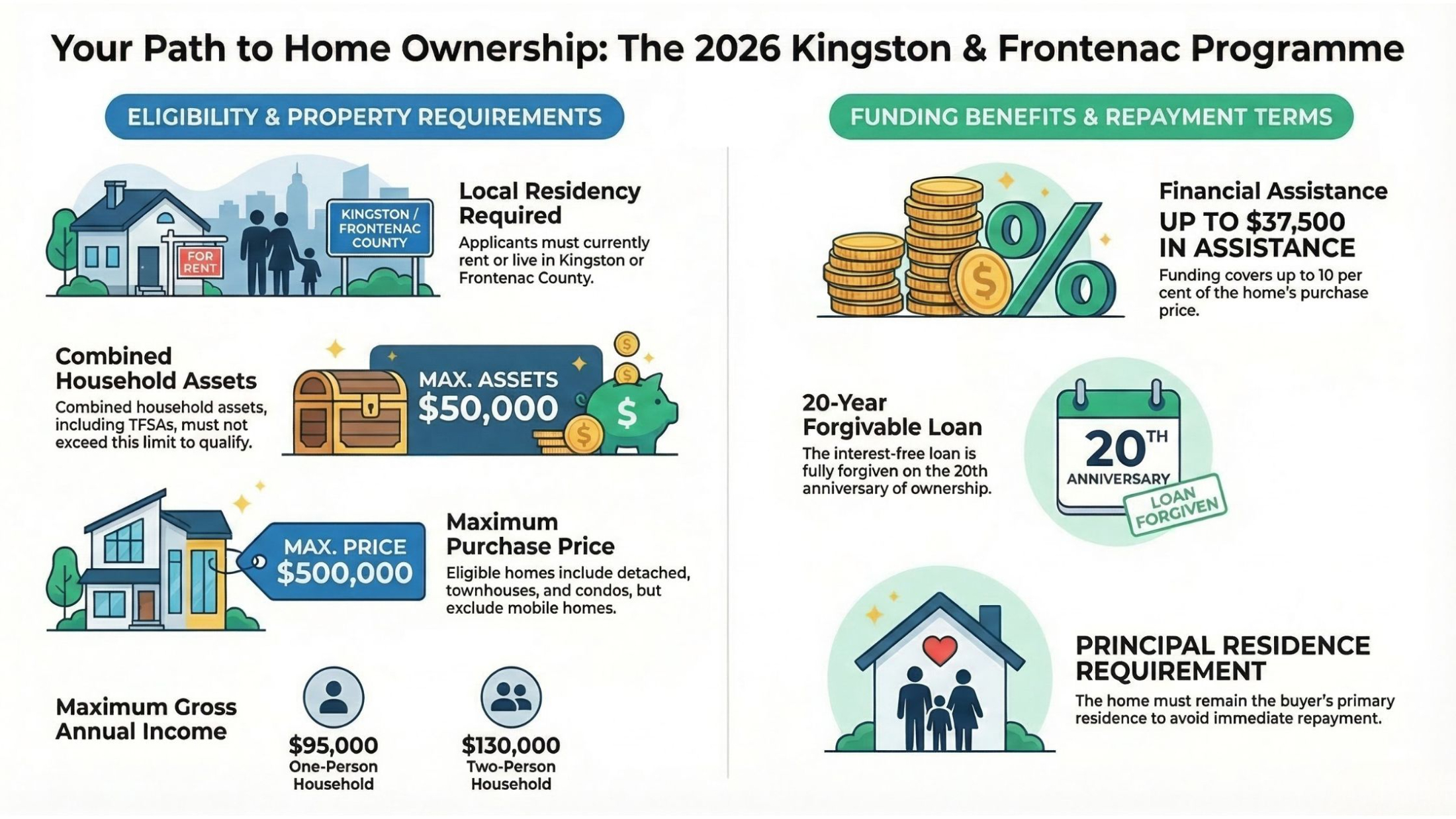
"The maximum funding is 10 per cent of the home's purchase price, up to $37,500."

From a strategist's perspective, $37,500 is more than just cash—it’s a way to potentially avoid high-ratio mortgage insurance premiums or to qualify for a more stable home that fits your long-term needs. This funding allows you to enter the market sooner, capturing appreciation early rather than chasing a moving target.

3. Takeaway 2: The 20-Year Path to Forgiveness

The structure of this assistance is unique and requires a long-term mindset. It is not a gift, but an investment in your residency within our community.

"It is a 20-year interest-free forgivable loan registered on the property's title."

Strategic Insight: You must view the City as an equity partner. If you remain in the home as your principal residence for the full 20 years, the loan is forgiven entirely—a 100% gain for you. However, if you sell or move out before that 20th anniversary, the "gotcha" applies: you must repay the original loan plus 10% of any capital appreciation. Essentially, if your home’s value grows, the City shares in that profit. The winning strategy here is clear: buy a home you can see yourself in for two decades to keep every cent of that equity for yourself.

4. Takeaway 3: Broad Eligibility with Strict Guardrails

The program is designed for modern, middle-income households, but the criteria are rigid. I must highlight that this program is strictly for those who can qualify for a mortgage on their own merit.

  • Residency & Status: You must currently live in Kingston or Frontenac County and be a Canadian Citizen or Permanent Resident.

  • First-Time Buyer: You cannot currently own property or have participated in this program previously.

  • Income Caps: Gross household income is capped at $95,000 for one-person households and $130,000 for two-person households.

  • Asset Limit: Your combined assets must not exceed $50,000.

Strategic Warning: The Co-Signer Ban

One of the most critical "deal-breakers" in the guidelines is that applications supported by a co-signer or guarantor are ineligible. You must be able to secure a mortgage pre-approval from an approved lender (bank, credit union, or MIC) based solely on the income of the residents who will live in the home. Additionally, be aware that while RRSPs and RESPs are exempt, funds in TFSAs and FHSAs are included in your $50,000 asset limit.

5. Takeaway 4: Flexibility and Its Limits

The program covers a wide range of lifestyles, with a maximum purchase price of $500,000. Eligible units include detached homes, semis, townhouses, and condominiums. However, there are several exclusions and requirements you must plan for:

  • Ineligible Properties: Mobile homes and multi-residential properties do not qualify.

  • The Inspection Rule: For all resale homes, a professional home inspection is mandatory, and you must provide the report to the City.

  • Program Exclusions: This funding cannot be combined with the Kingston-Frontenac Renovates Program.

Pro Tip: Do Not Sign Prematurely

Applicants who make an official offer on a property before receiving written application approval are automatically disqualified. You must have your Letter of Conditional Approval in hand before you sign an Agreement of Purchase and Sale.

6. Takeaway 5: The "First-Come, First-Served" Clock

This is a high-stakes race. Funding is limited, and the clock starts on Wednesday, April 1, 2026, at 8:30 a.m.

The most important strategic advice I can give is this: An incomplete application is a wasted application. You will not secure a spot in line until every piece of documentation is submitted. Use the time leading up to April to gather your "Submission Ready" folder:

  • Proof of Status: Birth certificates or Passports for all owners.

  • Tax Records: 2024 or 2025 Notices of Assessment (NOA) for all adults.

  • Bank Statements: The two most recent months for all accounts (including TFSA/FHSA).

  • Mortgage Pre-Approval: A signed letter from an approved lender (no private/unregulated lenders).

"Approved applicants... have 90 days to provide a purchase agreement; the closing date of the purchase may be beyond the 90 day date."

Once you are approved, you have a 90-day window to find your home. If you miss this window, the funding commitment is withdrawn.

7. Conclusion: Moving Toward Your Future

The 2026 Home Ownership Program is a rare opportunity to bypass the hardest part of the home-buying process. By staying the full 20 years, you aren't just securing a roof over your head; you are executing a financial strategy that builds significant wealth for your future.

As you prepare for the April 1st deadline, ask yourself: Where could you be by the 20th anniversary of your first home? With $37,500 in assistance and a clear-eyed strategy, that future is closer than you think.

Ready to start? We can help!

Kingston Homes <$500,000

Frontenac Homes <$500,000

Read

The Smarter Way to Protect Your Home and Family: Buy Life Insurance Separately

When you buy a home, your lender may suggest adding mortgage life insurance to your mortgage. It sounds like an easy add-on — who doesn’t want peace of mind knowing their family would be protected if something happened?

But here’s what most people don’t realize: a standalone life insurance policy usually offers better protection, more flexibility, and greater long-term value.

1. You Decide Who Benefits

With lender-provided mortgage insurance, if you pass away, the payout goes directly to your bank — not your loved ones.

When you own your own life insurance policy, your family receives the funds and decides how best to use them. They might pay off the mortgage, cover daily expenses, or invest for the future. That flexibility makes all the difference.

2. Your Coverage Doesn’t Shrink While You Pay the Same

Mortgage insurance only covers what’s left on your loan. As you pay it down, your coverage drops, but your premiums stay exactly the same — you pay the same for less.

Term life insurance works differently: the coverage amount stays level for the full term (like 20 or 30 years), no matter how small your mortgage balance gets.

3. It Ends When the Mortgage Ends

Once your mortgage is fully paid off, lender insurance disappears. The coverage ends automatically, and there’s nothing left to show for all those years of premiums.

Your own life insurance, on the other hand, continues providing coverage after the mortgage is gone. You can maintain it to help with other goals, like income replacement, retirement planning, or leaving a financial cushion for your family.

4. You Stay in Control

Mortgage insurance is tied to your lender. If you refinance or switch banks, it often ends — meaning you’ll have to reapply, and possibly pay more.

Personal life insurance belongs to you. It stays in place no matter where you bank, refinance, or live.

5. You Usually Get More for Less

Independent life insurance typically gives you more coverage for a lower premium. Instead of just protecting your mortgage balance, you can choose a policy amount that supports your family’s entire financial picture — not just the house.

6. Underwriting Happens Upfront — and That’s a Good Thing

Mortgage life insurance often has little screening upfront, but this can backfire. If you pass away, the insurer may investigate your health history and could reject the claim if something was missed.

Individual life insurance policies are fully underwritten before approval, so once your policy is in place, you can be confident your loved ones are protected — no surprises later.


The Takeaway

Mortgage life insurance may sound convenient, but it’s designed to protect the lender. A personal life insurance policy protects you and your family — ensuring your coverage stays stable, portable, and flexible, often at a lower cost.

If you’re buying a home or reviewing your mortgage, it’s worth speaking with an independent insurance advisor to find coverage that fits your life, not just your loan.


Disclaimer: We are not insurance experts or financial advisors. This information is intended for general educational purposes only and should not replace advice from a licensed insurance professional or financial planner.

Read

Planning Your Move in 2026: A Smart Real Estate Game Plan for Kingston & Area

If buying a home in the Kingston area is on your radar for 2026, the smartest move you can make is starting before you ever book a showing. The buyers who feel the most confident—and make the best decisions—are almost always the ones who planned ahead.

Why early planning matters

When you’ve already done the groundwork, you’re not scrambling when the right property comes along. You understand your options, you know what matters most to you, and you’re able to move forward thoughtfully instead of emotionally. That confidence makes a real difference in competitive situations and helps you avoid buyer’s remorse later.

Mortgage prep (without the pressure)

We’ll leave financial advice to your mortgage broker or financial advisor, but from a real estate perspective, clarity is key. Getting a pre-approval is a key first step. Knowing your comfortable price range, how different purchase prices affect your monthly costs, and what flexibility you have puts you in a much stronger position once you start viewing homes. We’re always happy to recommend trusted local mortgage professionals if you need a starting point.

Smart searches beat endless scrolling

One of the biggest mistakes buyers make is relying solely on public listing sites. Successful buyers are using custom, neighbourhood-specific searches that match how they actually want to live—not just how many bedrooms they need.

We help buyers fine-tune searches based on:

  • Neighbourhood preferences

  • School zones

  • Waterfront vs. town/city vs. rural living

  • Property type and long-term lifestyle goals

That way, when a new listing hits the market, you’re seeing it immediately—and you already know whether it’s worth a closer look. Not to mention Exclusive Listings that can no longer be publicly advertised. If we know what you’re looking for, we can keep an ear to the ground and give you the inside scoop. 

Local competition isn’t one-size-fits-all

Buying in Kingston looks very different from buying in Amherstview, Bath, Stone Mills, Gananoque, or the surrounding rural areas. Some neighbourhoods move quickly with multiple offers, while other areas reward patience and timing (although we know some of that is based on pricing strategy!).

Understanding these micro-markets—rather than reacting to broad headlines—is one of the biggest advantages of working with a local team that watches this market every day.

A simple first step

If 2026 is your buying year, getting set up early costs nothing and gives you clarity. A personalized home search lets you learn the market quietly, track patterns, and be ready when the right opportunity appears.

👉 Sign up for our VIP Home Search to receive listings tailored to your neighbourhood preferences, lifestyle goals, and timeline—before you ever feel rushed, or create your own custom search right here. If you’d like to book a buyer strategy session, contact us. And don’t forget to check out our free Buyer Resources and our Moving to Kingston Resources page.

Read

Can ChatGPT Be Your Real Estate Agent?

Short answer: it’s helpful… but it shouldn’t hold your cheque.

If you’ve Googled—or asked ChatGPT—questions like “Is now a good time to buy in Kingston?” or “What should I list my home for?” you’re not alone. More buyers and sellers in Kingston and area are turning to AI as a kind of real estate advisor or coach.

And honestly? That makes sense.

AI is fast, available 24/7, and very good at explaining things clearly. But when it comes to one of the biggest financial decisions of your life, there are a few important limits worth knowing—especially in a market as nuanced as ours.

So let’s talk about what AI is great at… and where a human still matters.

What AI Does Really Well

Let’s give credit where it’s due. AI is excellent at:

  • Explaining real estate terms without making you feel silly

  • Summarizing market concepts and trends

  • Helping you think through pros and cons

  • Generating good questions to ask your realtor or lender

In other words, it’s a great research assistant. If real estate were a school project, AI would be the kid who colour-codes the notes and brings extra highlighters.

Where AI Starts to Struggle

This is where things get interesting.

1. AI doesn’t actually know your neighbourhood

AI can talk about markets in general, but it doesn’t:

  • Walk your street

  • Know why two similar homes—one in the west end, one near downtown—can sell weeks apart

  • Understand the difference between lakefront, riverfront, and “water-adjacent”

  • Factor in ferry schedules, rural septic systems, or whether a road gets plowed first

Real estate in Kingston, Amherstview, Bath, Gananoque, and the surrounding rural areas is hyper-local. Sometimes hyper-specific. AI works in averages. Homes don’t.

2. AI doesn’t know your life

Real estate decisions are rarely just about numbers. AI doesn’t know:

  • You’re downsizing after decades in the same home

  • You want fewer showings because you work from home

  • You’d rather accept a clean offer than chase every last dollar

  • You’re juggling a move, kids, work, and aging parents

AI can be logical. It can’t be empathetic. And those two things don’t always line up.

3. AI sounds confident… even when it shouldn’t

This is a big one. AI is very good at sounding certain, even when:

  • Data is outdated or not neighbourhood-specific

  • Local factors aren’t being considered

  • Assumptions are being made quietly in the background

It won’t say, “This feels risky—let’s slow this down.”  Experienced local professionals say that all the time.

4. AI doesn’t negotiate

Negotiation is where real money and favourable terms are won or lost. AI can explain negotiation theory, but it can’t:

  • Read the tone of an offer

  • Sense when a buyer is bluffing

  • Pick up the phone and get context from another local agent

  • Push back firmly without derailing the deal

And it definitely can’t do it calmly when emotions are running high.

5. AI isn’t accountable

This part matters more than most people realize. If something goes sideways:

  • AI doesn’t attend inspections

  • AI doesn’t talk to your lawyer, lender, or insurer

  • AI doesn’t flag local issues that only come up mid-transaction

There’s no follow-up. No fixing it. No “we’ve got this.”

The Best Way to Use AI in Real Estate

Here’s the sweet spot. Use AI to:

  • Learn

  • Prepare

  • Organize your thoughts

  • Ask better questions

But rely on a human to:

  • Interpret Kingston-area market data properly

  • Apply local knowledge and judgement

  • Adjust strategy in real time

  • Negotiate and manage the details

Think of AI as your assistant, not your decision-maker.

The Bottom Line

AI is a fantastic place to start. But when it comes to pricing your home, navigating offers, or making a move in Kingston and area, most people want:

  • Local insight

  • Clear advice

  • Someone who understands both the market and the moment

  • A real person who is accountable for the outcome

Real estate is still a very human business. And when your home—and your future—are involved, that’s a good thing.

If you’re using AI to get oriented and want a local, human perspective to go with it, we’re always happy to talk things through—no obligation, no sales pitch.


Read

Choosing the Best Realtor® in Kingston and Area

A practical guide for buyers and sellers in Kingston, Napanee, Bath, Amherstview, Stone Mills, Gananoque, and surrounding areas.

When people say they want “the best real estate agent,” they usually mean someone they can trust, who understands the local market, communicates clearly, and helps them reach their goals with less stress. There’s no universal top-10 list that can decide that for you—but there is a smart way to choose.

Here’s how to find the right Realtor® for your move, especially if you’re buying or selling in Kingston and area.


Step 1: Define What “Best” Means to You

“Best” is personal. Before you search, get clear on your priorities:

  • Are you buying, selling, or doing both?

  • Is your goal top price, a smooth timeline, or minimal disruption?

  • Do you need a specialist—downsizing in Amherstview, waterfront homes, rural properties, or relocation near CFB Kingston?

Once you know what matters most, the right agents naturally stand out.


Step 2: Focus on Local, Not Flashy

Strong local presence beats big promises every time. Look for agents who:

  • Clearly explain the Kingston-area market on their website

  • Are active on Realtor.ca and Google Business Profiles

  • Have recent sales in your neighbourhood—not just “nearby in Ontario”

True local agents know the difference between Bath, Amherstview, west-end Kingston, and rural Frontenac, because they’re working in these communities every week.


Step 3: Read Reviews Strategically

Online reviews are incredibly helpful—if you read them the right way.

  • Prioritize recent reviews over older ones

  • Look for specific stories, not generic praise

  • Watch for patterns around communication, negotiation, and follow-through

A downsizer praising calm guidance or a buyer noting clear explanations during multiple offers tells you far more than “Great experience!”


Step 4: Check Experience Where It Counts

Longevity alone doesn’t equal expertise. Ask about:

  • Recent sales in your price range and neighbourhood (for example, student rentals in Kingscourt)

  • Familiarity with local issues like wells, septic systems, zoning, condo fees, and inspection norms

  • How they explain market stats—days on market, pricing trends, and offer strategies—without jargon

The right real estate agent should make complex information easy to understand.


Step 5: Interview Two or Three Agents

This is a professional hire—treat it like one. Good questions include:

  • “What’s your strategy for my situation?”

  • “Can you share recent examples similar to my move?”

  • “How do you communicate, and how quickly can I expect replies?”

  • “What challenges should I expect in today’s market?”

Listen for thoughtful answers grounded in real experience, not rehearsed scripts.


Step 6: Pay Attention to Communication and Chemistry

Even the most skilled agent isn’t a fit if communication feels off.

  • Do they listen before offering advice?

  • Are explanations clear and pressure-free?

  • Do you feel respected and supported?

You should feel calmer after conversations—not more stressed.


Step 7: Look Behind the Scenes

Strong agents run strong systems. Ask about:

  • Administrative and marketing support

  • Coverage if they’re unavailable

  • How they manage multiple clients without delays

Behind-the-scenes structure is what keeps your transaction moving smoothly.


Step 8: Review the Plan Before You Commit

Before signing anything, expect clarity.

  • Sellers: pricing strategy, preparation timeline, marketing plan (professional photography, video, online exposure, open houses)

  • Buyers: search setup, neighbourhood guidance, offer strategy, and competitive market advice

If the plan feels vague, ask more questions.


How We Help Our Clients

Our clients often tell us the same things in their reviews: they value clear explanations, steady communication, and guidance that reduces stress. Whether we’re helping first-time buyers, downsizers, or sellers navigating a transition, we focus on education, preparation, and thoughtful negotiation—not pressure.

We believe that good real estate advice should be calm, informed, and supportive, with your goals guiding every decision.


Final Thought

Choosing the right Realtor isn’t about finding the loudest voice online—it’s about finding the professional who understands your market, listens to your needs, and earns your trust. Take the time to choose well. Your future self will thank you.

If you’d like to talk through your situation or compare approaches, we’re always happy to have that conversation.

Let’s Chat


Read

What Are Off-Market Properties or Exclusive Listings in Ontario?

You may have heard the terms exclusive property or off-market listing  and wondered what they really mean. In Ontario, exclusive listings are still allowed, but the rules around how they’re handled have changed significantly — especially when it comes to marketing.

An exclusive listing is a signed agreement between a seller and one brokerage to list a property for sale without putting it on MLS®. The property is for sale, but it’s not publicly advertised. That means no lawn signs, no social media, no websites, and no broad promotional campaigns.

Under today’s rules, an exclusive listing can only be shared privately:

  • Within the listing brokerage, and

  • One-on-one with individual agents or individual buyers

If a property is advertised publicly in any way, it must be placed on MLS® within 3 days.


Why Would Someone Choose an Exclusive Listing?

While most sellers benefit from full exposure on MLS®, exclusives can make sense in certain situations, such as:

  • Privacy concerns (high-profile individuals, sensitive circumstances, divorce, medical issues, etc.)

  • Preparing the property before going public (repairs, staging, photography, paperwork)

  • Testing timing or price quietly, without a public days-on-market clock

In these cases, exclusive listings offer more control and discretion.


Why Did the Rules Change?

The Canadian Real Estate Association (CREA) introduced these policies in January 2024 to promote fairness and transparency. Broad public advertising of exclusives was limiting buyer access and sometimes reducing competition for sellers — which could impact sale price. Today’s structure ensures sellers understand the trade-offs and that buyers are treated equitably.


How Do Buyers Find Exclusive Listings?

Because they won’t appear on Realtor.ca or be advertised publicly, access happens within brokerages and through relationships, networking, and agent-to-agent communication. Working with a local REALTOR® who’s well connected is the best way to hear about opportunities that aren’t yet on the public market.


Is an Exclusive Listing Right for You?

For many properties, MLS® exposure is the best path to achieving maximum value. But depending on your goals, privacy needs, or timing, an exclusive listing can be a strategic option.

If you’d like to talk about whether exclusive or off-market makes sense for your situation — or if you want to be kept in the loop about private opportunities in Kingston and area — we’re always happy to chat.

Read

Top Mistakes First-Time Homebuyers Make (And How to Avoid Them)

Buying your first home is an exciting milestone but can also be overwhelming. In Kingston, Ontario, a city rich in history and charm, first-time homebuyers often need to correct common mistakes that can lead to frustration, delays, and unnecessary costs. Whether you're looking at a cozy townhouse in the downtown core or a spacious family home in one of Kingston's beautiful neighbourhoods, understanding these potential pitfalls can help you avoid them and make the process smoother. Here are some of the most frequent mistakes first-time homebuyers in Kingston make — and how to avoid them.

Not Getting Pre-Approved for a Mortgage

One of the biggest mistakes first-time homebuyers make is failing to get pre-approved for a mortgage before starting their home search. It's tempting to jump right into browsing listings and imagining your dream home, but you need a clear understanding of your budget to set yourself up for disappointment.

How to Avoid It: Talk to your bank or a local mortgage broker about your budget and all of the costs involved in home buying. They will get the information from you necessary to get your pre-approval for a mortgage. It's important to do this before you start looking at homes because it gives you a clear idea of how much you can afford. Also, once you've found the home you would like to make an offer on, a pre-approval can also speed up the buying process, making your offer more competitive in a market where homes can sell quickly.

Side note: Even with a pre-approval you will still need a finance condition on your offer. The pre-approval tells you how much your budget is, but the actual mortgage approval tells you whether your lender will give you a mortgage on that particular house. If you do not have a pre-approval, your finance condition will have to be much longer than a seller may be willing to wait, depending on the market, so get it done before you start looking!

Overlooking Extra Costs Beyond the Listing Price

Many first-time buyers only focus on the listed price of a home, but the true cost of homeownership goes far beyond that. Closing costs, property taxes, insurance, and home maintenance fees can all add up, and these extra expenses may blindside some buyers.

How to Avoid It: Factor in additional costs when budgeting for your home purchase. A general rule of thumb is to set aside 3-5% of the home's purchase price for closing costs. You'll also want to budget for ongoing costs such as utilities, repairs, and upgrades.

Skipping the Home Inspection

Kingston has many older homes with character, and while that's part of their charm, it can also mean potential hidden issues. Some buyers may feel rushed or tempted to skip the home inspection to save time and money, but this is one of the biggest mistakes you can make. Even newer homes may have issues, so it's always best to do the home inspection.

How to Avoid It: Always hire a qualified home inspector to assess the property before you commit to buying. A good inspector will help you uncover potential issues, from foundation problems to outdated electrical systems, which could save you thousands of dollars in repairs down the road.

Not Considering Future Needs

Getting caught up in the excitement of finding your perfect first home is easy, but it's also important to think about the future. Will the house still suit your needs in five or ten years? For example, you may need more space or proximity to schools and parks if you plan to start a family.

How to Avoid It: When buying your first home, think about your long-term needs. Consider factors like the size of the home, the neighbourhood, and the potential for growth or renovations. This will help ensure that your home remains a good fit for you as your lifestyle evolves.

Neglecting the Importance of Location

While the house itself is important, the location is just as critical. A great home can quickly lose its appeal if it's located in an area with low rated schools, long commutes, or limited access to amenities. Many first-time buyers need to focus more on the neighbourhood rather than on the house.

How to Avoid It: Research the area thoroughly before making an offer. Look into things like school ratings, public transportation options, local amenities, crime rates, and future development plans. Consider how the neighbourhood aligns with your lifestyle and long-term goals. Drive through the neighbourhood during the day and in the evening to get a good feel for it.

Failing to Account for Market Conditions

The real estate market in Kingston can fluctuate, and not understanding the current market conditions could lead to overpaying for a home or missing out on opportunities. First-time buyers sometimes need help understanding whether it's a buyer's or seller's market.

How to Avoid It: Work with a local real estate agent who understands the Kingston market. They can provide insights into current trends and help you make an informed decision about when to buy. Your agent will also be able to advise you on pricing strategies, helping you avoid overpaying.

Letting Emotions Overrule Logic

It's easy to get emotionally attached to a home, especially if you find one that feels perfect. However, letting emotions drive your decisions can lead to making impulsive choices, such as overbidding on a property or neglecting issues that could become costly.

How to Avoid It: While it's natural to feel excited about a new home, try to stay objective. Focus on the facts, such as the home's condition, price, and how well it meets your needs. Don't rush into a decision; take your time and keep emotions in check.

Ignoring the Importance of Resale Value

Many first-time homebuyers focus on the present and overlook the future. While you might love the house you're considering now, what about five or ten years down the road? If you plan to sell eventually, it's essential to consider the resale value of your home.

How to Avoid It: When choosing a home, think about its potential resale value. Look for homes in desirable neighbourhoods with a history of strong market performance. Consider factors like the home's layout, size, and condition and how likely it is to appeal to future buyers.

Buying your first home in Kingston can be a rewarding and exciting journey, but avoiding these common mistakes along the way is important. By staying organized, working with a knowledgeable real estate agent, and being mindful of the costs and long-term considerations, you can ensure that your first home is a good investment and a place where you'll thrive for years to come.

If you're ready to start your home-buying journey in Kingston, contact us for expert advice and guidance every step of the way!

Read

First-Time Home Buyer’s Guide: How to Buy a House in Kingston, Ontario

Buying your first home is exciting—but it can also feel like a big leap. If you're looking to buy your first house in Kingston, Ontario, you’re not alone. This vibrant city is a popular choice for first-time buyers thanks to its walkable neighbourhoods, historic charm, and access to education, healthcare, and waterfront living.

Here’s what you need to know to confidently buy your first home in Kingston.

1. Get Pre-Approved Before You Start Looking

In Kingston’s competitive real estate market, a mortgage pre-approval is essential. It helps you:

•Understand what you can afford
•Lock in an interest rate
•Strengthen your offer when competing with other buyers

Most local buyers work with a mortgage broker or a lender from institutions like Alterna Savings, RBC, or TD Canada Trust. We can recommend local lenders who we trust to take care of our clients.

2. Explore Kingston Neighbourhoods for First-Time Buyers

Kingston has a mix of neighbourhoods that suit a variety of lifestyles and budgets. A few top picks for first-time home buyers:

•Polson Park: Quiet, affordable, close to parks and transit
•Kingscourt: Up-and-coming, walkable, close to downtown
•Cataraqui North: Newer builds, close to schools and big-box stores
•Rideau Heights: Great value and improving amenities
•Greenwood Park / East End: Family-friendly, close to CFB Kingston and downtown via the Waaban Crossing

We can help you match your lifestyle and commute needs to the right area.

3. Know the Costs Beyond the Mortgage

Budgeting for your first home in Kingston means more than just your monthly payment. Be sure to plan for:

•Property taxes (approx. 1.2% of assessed value in Kingston)
•Utilities (Enbridge gas, Utilities Kingston for water/hydro)
•Home insurance
•Legal fees and disbursements
•Home inspection
•Land transfer tax (Ontario provides a rebate of up to $4,000 for first-time buyers)
•Moving costs and immediate repairs

4. Take Advantage of First-Time Buyer Incentives

If you're a first-time home buyer in Ontario, you may be eligible for:

•The Home Buyers’ Plan (HBP): Withdraw up to $60,000 tax-free from RRSPs
•Land Transfer Tax Refund: Up to $4,000 back in Ontario
•The new First Home Savings Account (FHSA): Save up to $8,000/year tax-free

Ask your mortgage broker or REALTOR® to help you determine what you qualify for.

5. Work with a Kingston-Based REALTOR®

A local real estate agent knows the ins and outs of Kingston’s neighbourhoods, pricing trends, and offer strategies. Your agent will:

•Guide you through listings that fit your budget and goals
•Advise on offer strategies (including conditions)
•Connect you to trusted home inspectors, lawyers, and contractors
•Help you avoid common pitfalls in older homes (like knob-and-tube wiring or outdated insulation)

Bonus: In most cases, buyers don’t pay commission—the seller does.

6. Understand the Buying Process in Ontario

Here’s what to expect when buying your first home in Kingston:

1.Get mortgage pre-approval
2.Start viewing homes with your REALTOR®
3.Make an offer (often with conditions like financing or inspection)
4.Fulfil conditions and finalize financing
5.Sign documents with a lawyer
6.Close and get your keys!

In Kingston, homes can sell quickly—especially under $600,000—so be ready to act fast when you find the right one.

7. Is Kingston a Good Place to Buy a First Home?

Yes—Kingston continues to attract first-time buyers because of:

•A strong job market (healthcare, education, public service)
•Stable property values
•A mix of housing types (detached homes, townhouses, condos)
•Easy access to Toronto, Ottawa, and Montreal
•A lifestyle that balances urban amenities with natural beauty

Final Thoughts

Buying your first home in Kingston, Ontario is an exciting milestone—and with the right plan, it’s completely achievable. Surround yourself with trusted professionals, take advantage of first-time buyer programs, and choose a neighbourhood that fits your life today and tomorrow.

Thinking about buying your first home in Kingston?

We specialize in helping first-time buyers make smart, confident choices. Reach out for a no-pressure chat or to get started.

Serving Kingston, Amherstview, Napanee, and the surrounding region.

Read

Saving for Your First Home

When Lorna and I purchased our respective first homes, it was a very different real estate landscape than it is now. Lorna worked with a financial planner to sort out her finances and move toward a down payment on her new build condo, and I worked with my husband squirrelling away portions of our salaries for a down payment on our eventual east end fixer-upper semi. However, with rising real estate prices and additional costs like closing fees and taxes, saving for your first home can feel like an overwhelming challenge. The good news is that Canada offers a range of tools, programs, and tax benefits designed to help first-time home buyers achieve their dream of homeownership. By combining smart financial planning with these supports, you can make the goal of owning your first home a reality.

Minimum Down Payment Requirements in Canada

In Canada, the amount you need for a down payment depends on the home’s purchase price. The federal government has established the following minimum down payment requirements based on the home’s purchase price:

· For homes priced at $500,000 or less, a minimum of five per cent of the purchase price is required.

· For homes priced between $501,000 and $999,999, a minimum of five per cent for the first $500,000 and 10 per cent for any amount over $500,000 is required.

· For homes priced at $1 million or more, a minimum of 20 per cent of the purchase price is required.

While these are the minimum requirements, saving beyond the minimum can provide benefits and ultimately save you money through lower monthly mortgage payments and less interest paid over the life of the loan.

Savings Strategies to Help Save for Your First Home

There are several tools and programs designed specifically to help first-time home buyers. One of the simplest ways to stay on track is to open a new savings account for first-time homebuyers specifically to save for the down payment. Many financial institutions provide accounts specifically for first-time buyers. Look for accounts offering high interest rates, low or no fees, and flexibility to suit both short- and long-term savings goals.

A Tax-Free First Home Savings Account (FHSA) is a registered account that combines the tax advantages of an RRSP and a TFSA, making it the best savings account for first-time homebuyers and building your down payment savings. You can contribute up to $8,000 annually, with a maximum lifetime contribution of $40,000. Contributions are tax-deductible, which can reduce your taxable income, and withdrawals from your tax-free savings account for first-time homebuyers remain tax-free as long as they are used to purchase a qualifying first home.

Government Support Programs for First-Time Homebuyers

The Canadian government offers a variety of incentives to help first-time homebuyers reduce costs and make homeownership more accessible. These programs can significantly reduce upfront costs and make it easier to afford your first home when combined with your personal savings efforts.

Home Buyers Plan

The Home Buyers’ Plan (HBP) allows first-time home buyers to withdraw up to $60,000 each, tax-free from their Registered Retirement Savings Plan (RRSP), to use toward their home purchase. This program provides an excellent way to access pre-existing savings while avoiding immediate tax implications. However, the HBP requires that you repay the withdrawn amount over a maximum of 15 years, beginning in the second year after the withdrawal.

GST/HST New Housing Rebate

If you’re purchasing a newly constructed home, substantially renovating an existing one, or rebuilding after a fire, you may be eligible for a rebate on a portion of the GST or HST paid. The rebate can significantly offset the additional costs of buying or building a new home. Eligibility and rebate amounts depend on the province and the price of the house.

Land Transfer Tax Rebates

Many provinces and municipalities offer tax savings for first homebuyers to reduce the cost of land transfer taxes. The exact rebate will vary by location but can provide substantial savings on closing costs.

Home Buyers’ Tax Credit (HBTC)

The Home Buyers’ Tax Credit is another federal incentive designed to help first-time buyers recover some of the costs of purchasing a home. This non-refundable tax credit offers up to $1,500 in tax relief, which can be used to offset expenses like legal fees, appraisal costs, and land transfer taxes.

How to Start Saving for Your First Home

Saving for your first home is an exciting journey but requires significant financial planning. Here’s how you can get started.

1. Determine how much you’ll need for your down payment and other costs. Remember to account for other expenses, such as closing costs and home inspection fees.

2. Evaluate your monthly income and expenses to see where you can cut back. In your budget, focus on prioritizing essential needs while reducing discretionary spending.

3. Set aside a manageable portion of your monthly income. Even small contributions add up over time, especially when invested in high-interest or tax-advantaged accounts.

4. Review your savings progress to ensure you’re on track to meet your goal within your desired timeline. If you’re falling behind, adjust your budget or explore additional sources of income.

We understand the challenges of saving for your first home, and we are here to guide you every step of the way. Let us help you find not just a property but a place to call home. 

Read

Using Your RRSP to Buy a Home in Kingston: What You Need to Know

Are you considering using your Registered Retirement Savings Plan (RRSP) to purchase a home in the Kingston area? Understanding the Home Buyers' Plan (HBP) can be a valuable step in making homeownership more attainable.

What is the Home Buyers' Plan (HBP)?

The HBP is a federal program that allows first-time homebuyers to withdraw up to $60,000 (increased from $35,000 for withdrawals made after April 16, 2024) from their RRSPs to buy or build a qualifying home. For couples, this means a potential combined withdrawal of $120,000. The withdrawn amount is not taxed, provided it's repaid into the RRSP within a 15-year period.

Eligibility Criteria

To participate in the HBP, you must:

  1. Be a Canadian resident at the time of withdrawal and up to the time a qualifying home is bought or built.

  2. Meet the definition of a first-time homebuyer, meaning you have not owned and occupied a home in the previous four calendar years, excluding the 30 days before withdrawal.

  3. Have a written agreement to buy or build a qualifying home for yourself or a related person with a disability.

  4. Intend to occupy the home as your principal residence within one year of purchase or construction.

Even if you or your spouse have previously owned a home, you may still be considered a first-time homebuyer if certain conditions are met.

How to Withdraw from Your RRSP Under the HBP

Once you've confirmed your eligibility and have a purchase agreement in place, follow these steps:

  1. Complete Form T1036: Fill out the "Home Buyers' Plan (HBP) Request to Withdraw Funds from an RRSP" form.

  2. Submit to Your RRSP Issuer: Provide the completed form to your RRSP provider, who will process the withdrawal.

  3. Receive Funds: The funds will be released to you without withholding taxes.

Ensure that the RRSP funds you plan to withdraw have been in the account for at least 90 days to avoid potential tax implications.

Repayment Terms

Repaying the withdrawn amount is crucial to avoid tax penalties. Here's how it works:

  1. Repayment Period: Normally, you have 15 years to repay the amount, with the first payment due two years after the withdrawal. However, for withdrawals made between January 1, 2022, and December 31, 2025, the repayment period starts after five years instead of two.

  2. Annual Payments: Each year, repay at least 1/15 of the withdrawn amount.

  3. Missed Payments: If you miss a payment, the outstanding amount for that year will be added to your taxable income.

For withdrawals made between January 1, 2022, and December 31, 2025, the start of the repayment period is extended to five years.

Pros and Cons of Using the Home Buyers Program
Pros:

  1. Interest-Free Loan: Access your RRSP funds without interest charges.

  2. Boosted Down Payment: Increase your down payment, potentially reducing mortgage default insurance premiums.

Cons:

  1. Repayment Obligation: Mandatory repayments over 15 years.

  2. Opportunity Cost: Withdrawn funds lose potential investment growth during the repayment period.

  3. Discipline Required: Strict adherence to the repayment schedule is essential to avoid tax consequences.

Consult with Professionals

While the HBP offers significant advantages, it's essential to consult with financial advisors, mortgage professionals, or tax professionals to understand the full implications based on your personal circumstances. All of the information can be found on the canada.ca website, but we know sometimes it needs a bit of an explanation. At Lynn & Lorna Real Estate, we're committed to guiding you through every step of your home buying journey in the Kingston area. Whether you're looking to discuss the HBP, have questions about the local market, or looking for a mortgage specialist recommendation, don't hesitate to reach out.

Read

Home Buying Lawyers, Costs, and Deposits

Are you considering purchasing a home in the Kingston area? Understanding the roles of key professionals and the associated costs is vital for a smooth transaction. In this guide, we'll delve into the importance of a real estate lawyer, the typical expenses involved in buying a home, and the significance of the deposit in Ontario's real estate market.

The Role of a Real Estate Lawyer in Ontario

A real estate lawyer is indispensable in ensuring that your property purchase adheres to Ontario's legal standards. Their responsibilities encompass:

  • Conducting Title Searches: They verify that the property's title is free from liens, encumbrances, or disputes, ensuring you receive clear ownership.

  • Managing Financial Transactions: Your lawyer handles the transfer of funds, including the down payment and closing costs, ensuring timely and accurate payments.

  • Registering Legal Documents: They facilitate the official transfer of property ownership by registering the necessary documents with the provincial government.

  • Providing Legal Advice: Throughout the process, your lawyer offers guidance on legal matters, helping you navigate any complexities that arise.

Engaging a knowledgeable real estate lawyer ensures that all legal aspects of your home purchase are meticulously managed, providing peace of mind during this significant transaction.

Understanding the Costs Involved in Buying a Home

Purchasing a home involves several costs beyond the property's purchase price. Key expenses include:

  • Legal Fees: In Ontario, real estate lawyer fees for a standard residential purchase typically range from $999 to $1,500 plus tax. These fees cover services such as document preparation, title searches, and the facilitation of financial transactions.

  • Disbursements: These are out-of-pocket expenses incurred by your lawyer on your behalf, including:

  • Title Search Fees: To confirm the property's legal ownership status.

  • Registration Fees: For registering the property's title and mortgage.

  • Software Transaction Charges: Related to the legal software used to manage the transaction. These can range from $50 to $100, depending on the software.

  • Banking Fees: Charges for processing bank drafts, wire transfers, and other transactions, which can range from $25 to $100, depending on the number of payouts required.

  • Land Transfer Tax (LTT): This provincial tax is based on the property's purchase price. In Ontario, the LTT is calculated as follows:

  • 0.5% on the first $55,000

  • 1.0% on the portion from $55,001 to $250,000

  • 1.5% on the portion from $250,001 to $400,000

  • 2.0% on the portion above $400,000

  • 2.5% amounts exceeding $2,000,000 where the land contains one or two single family residences

  • For example, on a $500,000 home, the LTT would be $6,475. First-time homebuyers may be eligible for a rebate of up to $4,000. There is a great Land Transfer Tax calculator here.

  • Title Insurance: This protects against potential issues with the property's title, such as fraud or undisclosed liens. The cost varies but typically ranges from $250 to $400.

  • Home Inspection: While optional, a home inspection is highly recommended to identify any potential issues with the property. The cost is usually around $500.

  • Appraisal Fee: If required by your lender, an appraisal assesses the property's market value and can cost between $300 and upwards of $1000, depending on the location and property.

  • Mortgage Insurance: If your down payment is less than 20% of the purchase price, you may need to purchase mortgage default insurance, commonly known as CMHC insurance (although there are other insurers). The premium is calculated as a percentage of the loan and can be added to your mortgage payments.

  • Adjustments: These cover any prepayments made by the seller, such as property taxes or in the rural areas around Kingston this often includes a propane tank fill up, that extend beyond the closing date. You'll reimburse the seller for the portion that applies after you take possession. This will be included in the closing costs that your lawyer calculates.

Being aware of these costs will help you budget effectively and avoid surprises during the home-buying process.

The Importance of the Deposit in Ontario Real Estate Transactions

In Ontario, the deposit is a critical component of the home-buying process, serving as a gesture of good faith and commitment from the buyer to the seller. Key aspects include:

  • Standard Deposit Amount: While there's no legal requirement, it's customary for deposits to be around 5% of the purchase price. For instance, on a $500,000 home, a typical deposit would be $25,000. In the Kingston area, it can be closer to $10,000, whereas pre-pandemic you might have seen $3,000 or $5,000 deposits.

  • Timing of the Deposit: These terms will be described in the Schedule A of the Agreement of Purchase and Sale. Generally in the Kingston area the deposit is due Upon Acceptance, but there are 3 options:

  • Herewith - the deposit is submitted with the Agreement of Purchase and Sale. If the offer is accepted by the seller(s), the cheque is deposited. If not, you can simply return to your bank and redeposit the funds back to your account.

  • Upon Acceptance - the deposit is due within 24 hours of the offer being accepted

  • As otherwise described in this Agreement - sometimes buyers pay several deposits. For example: a portion upon acceptance, and a portion after conditions are fulfilled or waived.

  • It's important to have these funds readily available when you make an offer on a property in order to avoid any breach of contract.

  • Form of Payment: Deposits are typically made via cheque, certified cheque, bank draft, e-transfer, or wire transfer.

Ready to Take the Next Step?

If you're considering purchasing a home in the Kingston area, understanding the roles of key professionals and the associated costs is important for a smooth transaction. Contact us today to connect with a knowledgeable real estate lawyer and get personalized guidance tailored to your needs. Let us help you make informed decisions and ensure your home-buying experience is seamless. Your dream home awaits—let's get started!

Read

Kingston and Area Real Estate Blog

Kingston & Area real estate insights from local REALTORS® Lynn & Lorna. market updates, buying & selling tips, neighbourhoods, local love, and smart local advice.

This website may only be used by consumers that have a bona fide interest in the purchase, sale, or lease of real estate of the type being offered via the website. The data relating to real estate on this website comes in part from the MLS® Reciprocity program of the PropTx MLS®. The data is deemed reliable but is not guaranteed to be accurate.